







Defining artificial intelligence in simple terms
At a basic level, artificial intelligence refers to systems that can perform tasks normally requiring human judgment. These include recognising patterns, learning from data, understanding language, and supporting decisions. When people ask what artificial intelligence or AI is, they are often looking for a single definition. In practice, AI is not one thing. It is a collection of techniques used to solve different types of problems. From a business perspective, AI is best understood as a way to extend human capability. It handles large volumes of data quickly and consistently. It does not replace expertise. It supports it. That distinction matters more than most technical definitions.Why AI suddenly feels unavoidable
AI has existed for decades, but only recently became widely useful. Early systems relied on fixed rules. They worked well in narrow situations and failed as soon as conditions changed. The shift came when systems began learning directly from data instead of relying on rigid instructions. Three forces pushed AI into the mainstream. Data became abundant. Computing power became cheaper. Algorithms improved. Together, these changes made AI practical rather than experimental. What is AI today, looks very different from what it was even ten years ago.The core components of AI
Most modern AI systems rely on three elements. Data, models, and feedback. Data is the foundation. Poor data leads to poor outcomes. Models are mathematical tools that find patterns within that data. Feedback allows systems to improve over time by learning from results. This ability to adapt is what separates AI from traditional software. In real organisations, AI rarely exists on its own. It is usually embedded into existing platforms such as analytics tools, CRM systems, or operational dashboards.Machine learning and executive relevance
Machine learning is a subset of artificial intelligence that allows systems to improve through experience. For leaders asking what is AI in operational terms, machine learning is often the most visible part. It powers demand forecasting, risk detection, predictive maintenance, and recommendation engines. A logistics firm might use it to predict delays. A finance team might use it to flag unusual transactions. These systems do not make final decisions. They surface insights that guide human judgment.Language based AI in everyday operations
Natural language processing allows AI systems to work with human language. It supports chatbots, document analysis, and internal knowledge tools. When leaders wonder what artificial intelligence (AI) is doing inside customer service or compliance teams, language models are often involved. When designed well, these tools reduce response times and standardise outputs. When designed poorly, they frustrate users. The difference usually comes down to training data quality and clear boundaries around when humans step in. Computer vision enables machines to make sense of images and video. You see it in factory quality checks, retail stock tracking, and security systems. It works best in settings where speed and consistency matter more than human judgement. For organisations evaluating what is AI worth investing in, computer vision often delivers clear returns in operational environments.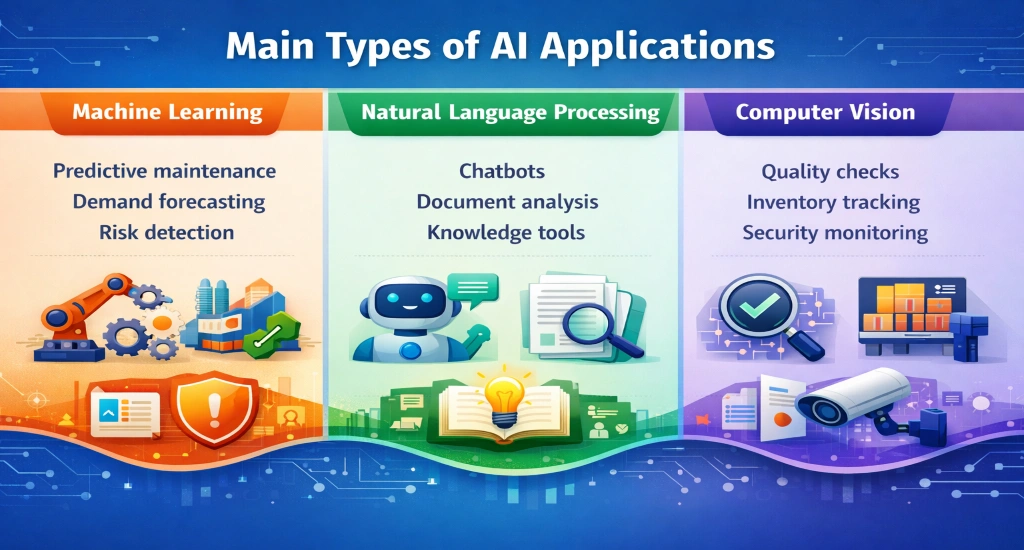
Automation is not always intelligence
A common misunderstanding is that all automation equals AI. Many automated systems follow fixed rules and never learn. AI driven automation adapts based on outcomes. This difference matters. Rule based automation improves efficiency. AI based automation improves adaptability. Both matter, but they serve different roles and demand different levels of oversight.Where AI creates real advantage
AI delivers the most value when it amplifies existing strengths. Companies with strong data assets or deep domain expertise gain more from AI than those chasing novelty. Key benefits include consistency, speed, and insight. AI applies logic evenly across thousands of decisions. It processes information faster than human teams. It reveals patterns that manual analysis misses. For leadership teams asking what is AI capable of delivering, the better question is where it removes friction or sharpens decision making.Reducing repetitive work without losing control
One of the strongest use cases for AI is handling repetitive tasks. Tasks like report creation, validating data, classifying tickets, and keeping an eye on systems can be automated. Done right, AI does the heavy lifting, freeing skilled staff for more meaningful work. When it works well, teams get back hours to focus on higher-impact tasks. Oversight still matters. Effective organisations define clear accountability and review mechanisms so automation supports decisions rather than obscuring them.Limitations worth taking seriously
AI systems reflect their training data. Any gaps, errors, or skewed data make their way into the outcomes. AI also struggles outside its training context. It does not understand intent or ethics in the way humans do. There are real organisational risks. Lax governance leads to compliance gaps, brittle systems, and eroded trust. AI should be treated strategically rather than as disconnected tools.
Regulation and trust in the UK and Europe
In the UK and Europe, adopting AI is heavily influenced by strict data protection laws and the way regulations are evolving. Transparency and accountability are quickly becoming baseline expectations. If interested, you can read about the UK AI regulation and data protection in detail. When exploring what artificial intelligence AI fits a particular use case, companies need to consider more than just technical feasibility. Reputation, compliance, and trust all matter. AI should build confidence, not chip away at it. Companies exploring what is artificial intelligence AI appropriate for their use case must consider more than technical feasibility. Trust, reputation, and compliance all play a role. AI should strengthen confidence, not undermine it.Choosing an AI approach that fits
Some organisations build AI systems in house. Others rely on external platforms. Many choose a hybrid path. The right choice depends on data sensitivity, internal skills, and long term goals. A practical starting point is identifying processes where decisions depend heavily on data and volume. Small pilot projects test assumptions and build confidence before scaling further.AI as an ongoing capability
Successful organisations treat AI as something that evolves.Models require monitoring. Data pipelines need care. Business conditions change. AI delivers long term value when companies invest in people, governance, and learning. It becomes an asset that improves over time rather than a one off project. Looking ahead AI is becoming less visible and more embedded. It will sit inside everyday tools rather than stand apart as a separate system. Decision support will feel more natural.Automation will become more contextual. For anyone still wondering what is AI or what is artificial intelligence in the context of future competitiveness, the key is integration, not replacement. AI will not replace leadership or strategy. It will reshape how they are executed. If you want to find out about top free AI tools that can help you on a daily basis,Final perspective
Artificial intelligence is neither a shortcut nor a threat. It is a powerful set of tools that, when used thoughtfully, reshapes how organisations operate.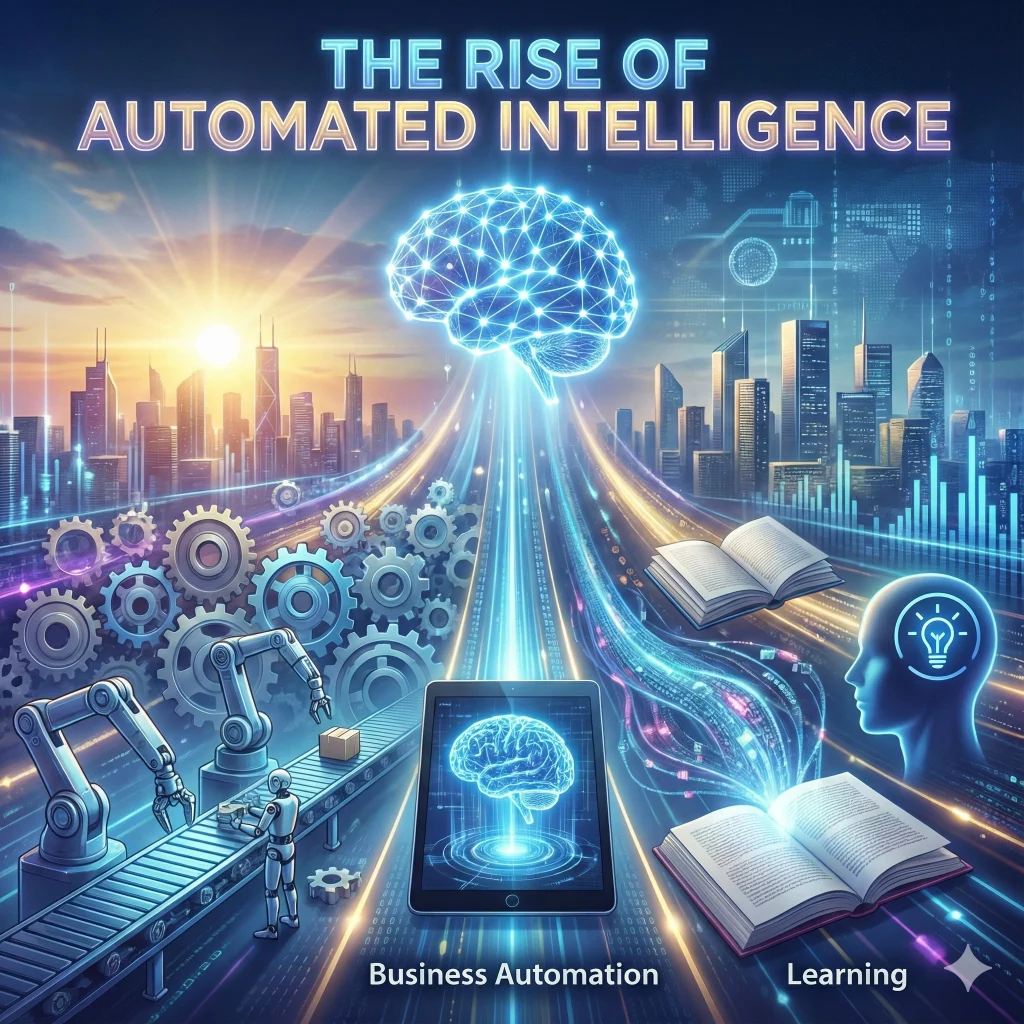
The modern corporate landscape is defined by its constant pursuit of efficiency. We have moved beyond the era of basic digitalisation, when converting a paper form into a PDF was considered an innovation. Today, the conversation in the top management teams, from the Chief Executive setting the vision to the Chief Technology Officer shaping the future is centred on a far more significant concept and that is automated intelligence.
This is not simply another mantra for automation. It represents the moment when traditional rule based process automation combines with the adaptive and cognitive capabilities of Artificial Intelligence. When a system can follow a process, learn from its environment, adapt to new contexts, and make appropriate decisions without human intervention, it transforms every repetitive task across the enterprise.
For companies seeking a genuine competitive advantage, the message is clear. Free your most skilled people from the mundane and enable them to focus on the mission critical. This article explores how automated intelligence is altering business workflows and how it is revolutionising corporate learning through artificial learning.

The Strategic Distinction: Intelligence Beyond the Rules
To use this capability effectively, it is essential to be clear about the terminology. Automation in the classic sense is a machine carrying out a predefined task. For instance, a software bot reading a particular cell in a spreadsheet and entering that value into a fixed field is performing simple automation.
Automated intelligence brings cognitive adaptability into play. To put this into perspective, consider when a system receives an invoice that has an unfamiliar format and, instead of failing, it uses Computer Vision and a predictive model to classify the document correctly, extract the required data, and route it for approval, all without a human writing a single new rule. This development elevates automation from a cost saving tool to a strategic engine for value creation.
Building the Adaptive Enterprise
For the technology squad, this transition is their central architectural challenge. The aim is to move from unadaptable and non-integrated systems to what is known as the Adaptive Enterprise. This new organisational structure is defined by workflows in which automated intelligence is embedded at every decision point.
In practice, this means the system can predict demand fluctuations in the supply chain, propose or decide new strategies by automatically adjusting stock levels based on those forecasts, and act by generating purchase orders and routing them to the appropriate suppliers. This all-encompassing capability yields considerable efficiency gains, giving technical experts more time to innovate and design smart layers, rather than maintain traditional, rule-based systems.

Automated Intelligence: Driving Change in Core Business Workflows
The practical benefits become clear when used within major corporate teams. Advanced intelligent systems are increasingly supporting or replacing these areas, which were previously burdened with repetitive cognitive tasks carried out by mid-level employees.
Finance and Accounting
Monthly closing, invoice processing, and expense reconciliation are repetitive and rule-heavy tasks by nature and human fatigue can add to the risk. Even small compliance errors can result in costly penalties. Automated intelligence offers a simple solution. AI-driven tools can now scan, verify, and process invoices in seconds. By using predictive analytics, these systems can identify important patterns such as duplicate payments, unusual suppliers, or missed compliance requirements. In auditing, AI reviews every transaction instead of relying on manual sampling, achieving a level of accuracy that was previously impossible.
The impact on finance teams is transformative. Transactional tasks are not eliminated but elevated, allowing professionals to shift their focus from routine work to strategic planning and financial analysis. By automating repetitive processes, teams gain efficiency, reduce errors, and can dedicate more time to initiatives that create genuine business value.
Human Resources and Onboarding
Within HR management, the onboarding process is burdened by extensive documentation, manual scheduling, and one-size-fits-all training. The automated intelligence solution can provide intelligent systems screen CVs, match candidates to open roles based on advanced skill mapping, and automate interview scheduling. More importantly, they personalise the onboarding experience. By analysing a new hire’s existing skills and comparing them with the required competencies, the system creates a bespoke training plan and reduces weeks of administrative labour.
Manufacturing and Logistics
Machine downtime in manufacturing is costly. Maintenance practices are typically reactive or based on fixed schedules, both of which can be costly, and logistics planning must be constantly optimized.
The automated intelligence solution helps predictive maintenance systems analyse sensor data in real time. They do not simply alert engineers to breakdowns. They predict when a component will fail with strong accuracy, allowing scheduled maintenance that reduces downtime and extends equipment life. In logistics, automated intelligence forecasts demand shifts, highlights supplier risks, and uses real time traffic and weather data to optimise delivery routes.
How Automation and Artificial Learning Work Together
The feasibility of automated intelligence to adapt and improve relies entirely on artificial learning. This refers to the continuous machine learning process through which the system absorbs new data, identifies patterns, and refines its algorithms for improved outcomes. The system becomes more capable with every transaction it processes.
The Evolution of Corporate Training
The most significant long term benefit for executive leaders is not in automating tasks, but in transforming knowledge acquisition through artificial learning. Traditional corporate training is static. Artificial learning reverses this approach. AI analyses an employee’s role, performance data, and skill profile to create a unique programme for that individual. If a sales employee is strong at lead generation but weak at negotiation, the system suggests specific content on negotiation techniques rather than generic training.
On the other hand AI enhanced virtual and augmented reality allows technical specialists to practise complex and high risk tasks in a safe environment. The AI acts as a coach, offering personalised feedback in real time. This form of hands-on artificial learning is vital in fast paced workplaces. Generative AI tools are now integrated into everyday workflows which means they explain concepts, summarise complex documents, cite sources, and produce short lessons tailored to any individual. This moves training from the classroom into the natural flow of work.
The true value of artificial learning is not only faster training. It is the preservation of institutional memory. When an expert leaves the organisation, the knowledge captured through automated intelligence remains and becomes part of the training experience for new employees.

The Risk of the Silicon Ceiling
As AI adoption increases, a new challenge emerges which is the risk of the Glass Ceiling also known as the Silicon Ceiling in technical fields. Research shows that executives adopt automated intelligence quickly, while frontline employees, whose tasks are most suitable for automation, are slower to adopt. This creates frustration, security concerns, and inconsistency across the organisation.
The practical solution is to close this gap by top managerial support, clear communication with staff, proper tool rollout, and dedicated employee training programmes. Staff must understand how AI improves their role and enables progression to higher value work rather than considering it a threat. This is more of a change management challenge than it is a technical one.
Governance and Explainability
No executive can afford the risks of decisions made by systems that cannot be explained, the point of using AI was to prevent guessing and incorporate data-driven prediction. When automated intelligence detects fraud or declines a loan request, it must be able to justify its reasoning. In this case, transparency becomes essential. In regulated industries such as finance or healthcare, automated intelligence must be implemented with robust governance frameworks and clear audit trails. Fully transparent AI policies ensure compliance, builds trust, and allows technical teams to identify and correct biased or faulty models.
The Next Step? Agentic Intelligence
The future of automated intelligence lies in agentic systems. You may ask what these systems are and you should know that these systems are not limited to simple tasks. They can plan, reason, and execute multi step objectives. For example an AI agent that is working in procurement with a goal to reduce supply chain risk by ten percent within the next quarter, would analyse supplier performance, identify risks, forecast future disruptions, flag high risk vendors, create contingency plans, and present recommendations for approval.
This moves the technology from task execution to strategic management. Automated intelligence becomes a powerful booster, allowing one senior expert to be able to manage complexities that once required a large team. The continued evolution of artificial learning will accelerate this transformation.
The Mandate to Adapt
The transformation driven by automated intelligence and artificial learning is already taking place. This is not a future concept. It is the operational reality for leading organisations.
For the Chief Executive, the strategic requirement is to use automated intelligence to improve efficiency, reduce repetitive work, and redirect human talent towards innovation. For the Chief Technology Officer and technical specialists, the objective is to build secure and adaptive systems that support this transition and ensure that artificial learning is reliable and fair.
Companies that adopt this change will work more quickly, efficiently, and with a clearer strategic vision. The moment to build an intelligent and adaptive enterprise has already arrived.
The working rhythm of business leaders has never been faster. For the CEO, the CTO, and the technical specialist alike, the core challenge of 2026 is not generating data, it is dealing with the overload. It is about finding that subtle market advantage in the routine tasks, turning repetitive, low impact work into an advantage.
This is where the revolution of free artificial intelligence tools reaches the C suite desk. If you have a limited budget, it is better to cross out the multimillion pound AI implementations of previous years. However, do have it in mind that sooner or later you will be in need of a customized AI solution for your business. But today and for early stages, the transformative gains often come from intelligent, accessible, and completely free platforms that can automate, analyse, and accelerate tasks, from synthesising market research to drafting complex code. If your business is in the early stages of its lifecycle now is time for testing and learning.
This article is not just a simple list. It is a strategic guide for incorporating free artificial intelligence into your existing corporate workflow. We will focus on the specific AI tools that genuinely influence corporate performance, allowing your most valuable resource, your skilled employees, to shift from execution to innovation.
Strategic Pilot Programs: Free AI as R&D
In 2026, the free model for AI represents a strategic opening for executives, alongside the internship programmes, by serving as an ideal, zero-risk research and development budget for automation within the enterprise. Before making financial commitments, developers purposefully provide significant free utility to demonstrate value and promote eventual paid scalability. This lets CEOs and senior executives check the main features, see how safe things are, and find out how much work they get done.
Strategic time can be recovered by automating cognitive tasks that are done in large amounts, like summarizing long reports and scheduling appointments. But these tools can automate repetitive tasks like code auditing and boilerplate generation. This helps the CTO and technical experts do more, and they can spend their time on high-value tasks. In information-rich fields like knowledge synthesis, where free AI solutions are already converting the tedious and time-consuming process of data consumption into instant clarity, this accelerated adoption is essential.
Let’s Dive into the Free Artificial Intelligence Tools
Perplexity AI
Conversational search with generated answers that include cited sources.
Rapid market research, competitive analysis summaries, and synthesising internal documents through collections. It is not a chatbot. It is a fact checker integrated with a search engine. Technical teams use it to obtain code explanations or vendor reviews instantly, complete with links to original technical papers.
Google Gemini
Access to powerful models such as Gemini 2.5 Flash and deep integration with Google Workspace, including Gmail and Docs, summarising email chains and meeting transcripts, drafting professional follow up emails, and brainstorming high level strategy documents. Its strength lies in proximity to data. If your company runs on Google Workspace, Gemini offers a unique layer of intelligence directly where the work is carried out, eliminating unnecessary copying and pasting.
Notion AI
AI writing and editing features integrated into the Notion ecosystem. Generating meeting agendas, converting raw meeting notes into structured action items, and drafting initial technical documentation or user manuals. It transforms an unstructured collection of notes into a living, searchable knowledge base. This is a valuable knowledge transfer and onboarding tool.
Cursor
A generative AI code editor with basic free tier features such as chat and context aware code generation based on your project files. The key strength is its ability to understand your existing codebase and provide contextual suggestions, significantly reducing the cognitive load of switching between an integrated development environment, documentation, and a standard chatbot. A technical specialist can use it to automatically generate unit tests or refactor small blocks of legacy code within minutes.
Zapier
Although not strictly an AI model, Zapier allows foundational workflow automation on the free tier, often incorporating a small AI step. For example, when a new lead is added to a Google Sheet, an AI action scores the lead’s urgency, and if it is high, a notification is sent to Slack which is an AI work management & productivity tool. It allows non coders to create powerful, cross platform automation sequences. This is a critical free artificial intelligence tool for the CTO who wants immediate productivity gains across applications.
Canva’s Magic Studio
Canva provides a generous free tier with AI powered features such as Magic Design, which turns text into a presentation outline, and background removal. The strategic value lies in democratising design. A sales team can create a professional, on brand deck from a simple text prompt within minutes, avoiding bottlenecks in the design department.
Gamma
A highly efficient presentation tool that uses AI to structure, format, and visualise content into clean slides or web pages. For the CEO, this greatly reduces the time spent adjusting PowerPoint formatting. It takes an outline and delivers a polished internal proposal or status update instantly.
Fireflies.ai and Otter.ai
Both these tools offer you a noticeable amount of free transcription and meeting summary minutes every month. Their advantage is not just limited to transcription, but they provide post meeting intelligence, create action item lists, and identify key decisions. A CEO or project manager can review a one minute summary of an hour long meeting, focusing only on essential outcomes.
Grammarly
It is very valuable, even though it is simple. The free version can find spelling errors, tell you what tone you’ve chosen, and make suggestions to help your writing be more clear. For communication with executives, especially emails or reports that are important or need to be sent outside of the company, it makes sure that professionalism and clarity are always present, which lowers the chance of misunderstandings.
The Data Security and Privacy Reality Check
The core limitation of any free tool is data sovereignty. Most free tools rely on your input to train their models, or they store data on their servers. You should never use the free tier of an AI tool to process highly sensitive, proprietary, or legally protected corporate data. The rule must be as follows. Use free AI only for summarisation of public facing reports, internal meeting notes, or non sensitive draft content. Paid enterprise versions exist to offer the security and data isolation required for trade secrets. The CTO must establish a strict data sensitivity protocol for all free artificial intelligence adoption.
For organizations where data security and proprietary control are paramount, the strategic move is toward building in-house capabilities. By developing customized AI agents and solutions within your own secure and firewalled corporate environment that are often utilizing open-source models or securely licensed frameworks, you transform a potential security liability into a core competitive asset. This dedicated approach ensures complete data sovereignty, eliminates third-party training risks, and allows the system to be precision-tuned to your unique, high-value workflows, giving your company an unrivaled edge while completely alleviating concerns about data leakage or external server storage.

Scaling Beyond the Free Wall
The best free AI tools will eventually reach their usage limit. This may involve rate limiting, feature restrictions, or slower processing. This is the point at which you assess return on investment. The best strategy is to treat the usage limit as a clear data point rather than a frustration. If your team consistently reaches the free cap on a tool such as Fireflies.ai, this demonstrates that the automated task, in this case meeting summarisation, is providing measurable value. This becomes the business case for purchasing the enterprise version or keeping in mind when you are developing your own AI solution. The free artificial intelligence tool serves as an internal concept validator.
The Next Frontier in Free AI
As we progress through 2026, the most exciting developments involve genuine agentic capabilities, where an AI tool does not just execute a single command but plans and executes a multi step workflow that is highly pivotal.
Although fully autonomous, high security AI agents remain within the paid enterprise domain, free artificial intelligence is making progress.
Self correction in data pipelines is possible by using a free model to validate data cleanliness before it enters a proprietary database and automated code review by using a free local model to find basic security issues or style guide problems in a pull request. This lets the senior engineer spend more time on complex decisions about how to structure the code. However, the challenge and opportunity lie in integration. The company that can securely link several high value free artificial intelligence services into a custom workflow will outpace competitors who depend on a single expensive out of the box solution.
The New Mandate for Corporate Efficiency
The expansion of powerful and accessible free artificial intelligence platforms in 2026 has created a necessary question for every executive. Are we strategically leveraging every tool that offers a competitive advantage without requiring capital expenditure
The role of the leader is to curate, secure, and humanise the output of these new technologies. The objective is clear. Use free AI to eliminate repetitive tasks that drain your team’s energy and reserve their high level cognitive focus for innovation, complex problem solving, and human relationship building, the elements that truly drive corporate growth.
You should start small, assess the security, measure the reclaimed time, and plan for the future. The era of accessible and impactful automation has arrived, and your competitive edge may well be hidden within the free tier.
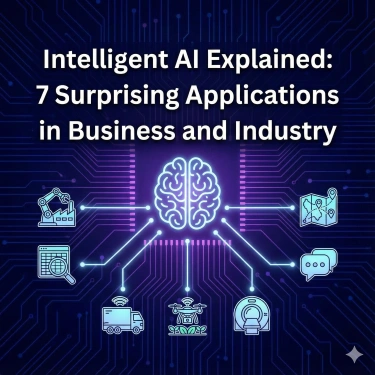
Modern corporations are no longer competing exclusively on speed, size, or pricing. Smart decision-making, automated optimization, and data-driven operations are the foundation of today’s true competitive advantage. This is where intelligent AI becomes a core business asset rather than a future concept. By integrating advanced intelligence-driven mechanisms into core business processes, organisations enhance their ability to adapt dynamically, predict outcomes, and optimise operations at scale.
Across industries, the most intelligent AI in the world is no longer confined to research labs. It is dramatically reshaping everything from healthcare systems, supply chains, customer operations, internal process management, education platforms, quality control frameworks to cybersecurity infrastructures. These systems don’t just follow a fixed script; they identify patterns, make strategic decisions, and refine processes over time.
At the foundation of this transformation stands intelligence in AI, enabling businesses to shift from static digital tools to living operational systems that evolve with real time data.
Intelligent AI in Personalised Healthcare Operations
In modern healthcare, precision is no longer an option. Intelligent AI is a powerful tool to personalize medical workflows by analysing patient data, medical imaging, behavioural patterns, and surpassing our expectation, genetic information can also be analysed. Treatment strategies are no longer based on statistical averages but on continuously updated individual profiles.
Through advanced diagnostic engines, intelligent agent architectures can play the role of an early disease detection tool, predictive risk analyst, and real time monitor of patient conditions. These agents continuously refine diagnostic accuracy as new data becomes available.
On the other hand, pharmaceutical research also benefits directly from intelligence in AI. Simulation driven drug discovery allows billions of molecular combinations to be tested virtually, reducing cost, shortening development cycles, and significantly improving success rates.
This level of intelligent automation is why the advanced healthcare networks rely on the most intelligent AI in the world to manage both clinical accuracy and operational efficiency.

Supply Chain and Logistics Powered by Intelligent AI
Global supply chains now operate under constant uncertainty created by demand fluctuations, geopolitical risks, transport capacity limitations, and regulatory complexity. Intelligent AI provides the adaptive control layer required to stabilise these environments.
Through real time data ingestion from multiple sources, intelligent agent systems simulate thousands of routings, warehousing, and sourcing scenarios. The system is constantly choosing an optimal path; a choice that relies on a delicate balance between economic profitability, speed of execution, and the level of risk involved.
To keep stock levels precise, AI forecasting synthesizes market trends, cyclical demand, marketing activities, and external economic data. This eliminates overstocking, frees trapped capital, and prevents sales from being lost. The resilient logistics networks today are built on the most intelligent AI in the world, where decision making is both predictive and corrective.
Process Management Through Intelligence in AI
Every organisation depends on hundreds of interconnected processes. Without continuous optimisation, inefficiencies become structural. Intelligent AI introduces self-correcting operational architectures that transform static workflows into adaptive systems.
By dissecting execution patterns, time spent, error frequency, and human interaction points, intelligent agents detect inefficiencies automatically and drive improvements based on real-time performance feedback. AI intelligence powers automated exception handling, predictive workload balancing, continuous compliance validation, and dynamic approval routing, everywhere from finance and procurement to HR and production planning. Instead of manual reengineering cycles, businesses operate on continuous intelligent optimisation powered by intelligent AI.
Personalised Education and Workforce Enablement
Enterprise learning is no longer driven by generic training modules. Intelligent AI now enables fully personalised learning environments that adapt to each individual’s performance, pace, and knowledge gaps.
By evaluating learning behaviour in real time, intelligent agent systems restructure course content dynamically. Difficulty levels, topic sequencing, and assessment logic, shift automatically to match learner capability.
This adaptive learning model, built on intelligence in AI, accelerates reskilling, strengthens internal talent pipelines, and increases knowledge retention across the organisation.
Many of the advanced enterprise academies are already driven by the most intelligent AI in the world, delivering high impact training at scale.

Intelligent AI in Quality Control and Operational Reliability
Traditional inspection-based quality control is no longer sufficient in high-speed production environments. Intelligent AI enables continuous quality validation through real time data analysis and computer vision.
Intelligent agent systems in manufacturing can inspect thousands of units per hour, swiftly exposing tiny defects that human eyes simply miss. Error patterns are then mapped to machine settings, raw materials, and operational variables.
In software, finance, and digital services, intelligence in AI monitors transaction accuracy, system stability, and performance anomalies continuously. Deviations are detected before they escalate into service failures.
This level of intelligent quality control is now standard in organisations using the most intelligent AI in the world for mission critical operations.
CRM and Customer Operations Driven by Intelligent AI
Customer relationship management has evolved far beyond static databases. Intelligent AI transforms CRM platforms into dynamic commercial intelligence systems.
Customer behaviour, purchasing patterns, communication responses, and service history are all analysed continuously. Intelligent agent models segment customers dynamically based on intent, not static labels.
Sales forecasting accuracy improves as intelligence in AI detects early buying signals and churn indicators. Marketing automation adapts campaigns in real time based on behavioural responses. Support operations become predictive rather than reactive, enabling proactive resolution strategies powered by intelligent AI.
Cybersecurity Built on Intelligence in AI
Modern cybersecurity cannot rely solely on predefined threat signatures. Attack patterns evolve faster than human analysts can respond. Intelligent AI introduces adaptive defence systems that learn continuously.
By establishing behavioural baselines across networks, users, and data flows, intelligent agent systems detect anomalies instantly. Suspicious behaviour is isolated automatically, preventing lateral movement and data breaches.
As attack methods evolve, intelligence in AI updates defence strategies without manual rule rewriting. This adaptive security layer is now a defining feature of the most intelligent AI in the world within enterprise infrastructure.
Why Intelligent AI Is Now a Structural Business Layer
Conventional software follows static logic, whereas intelligent AI operates on continuous feedback, learning from every outcome. This enables predictive decision making, self-optimising processes, autonomous anomaly detection, and real-time strategic adaptation. Each intelligent agent functions as a decision engine, perceiving its environment, reasoning over data, and executing actions to improve performance. This continuous learning cycle is what defines intelligence in AI and separates traditional automation from true intelligent systems.
The real power of intelligent AI emerges when it is deeply embedded into enterprise scale decision infrastructure rather than operating as a standalone tool. In modern organisations, dozens of fragmented systems generate massive volumes of operational data every second. When these data streams are unified under a central intelligent agent architecture, businesses gain a continuously learning operational brain. This central layer synchronises forecasting, optimisation, anomaly detection, and automated response across departments without human bottlenecks. As intelligence in AI matures, it enables cross functional optimisation where improvements in one department automatically propagate to others.
Finance, operations, sales, compliance, and production, no longer operate in isolation. The most intelligent AI in the world is designed precisely to orchestrate this level of enterprise-wide harmony. Through feedback driven optimisation loops, intelligent AI continuously refines decisions based on outcomes rather than predefined assumptions. Each intelligent agent improves accuracy through repeated exposure to real world variables. This transforms strategic planning from static forecasting into real time adaptive execution. Over time, the organisation itself becomes a learning system, driven by intelligence in AI rather than fixed managerial logic. This evolutionary capability is what positions intelligent AI as a permanent structural layer of future enterprises rather than a temporary optimisation trend.
As intelligent AI becomes more deeply integrated into business infrastructure, organisational roles and decision models also evolve. Leadership shifts from micro level operational control toward strategic orchestration of intelligent systems. Instead of approving every operational variable manually, executives supervise the behaviour of intelligent agent networks that execute thousands of micro decisions autonomously. This transition requires a governance framework powered by intelligence in ai itself, where transparency, auditability, and ethical boundaries are continuously monitored. The most intelligent AI in the world is not defined solely by its computational power, but by its controlled adaptability within regulated business environments.
Intelligent AI enables enterprises to absorb market volatility without destabilising internal operations. Pricing strategies, capacity planning, supplier selection, fraud detection, and customer engagement models adjust dynamically through learning based execution. Each intelligent agent functions as a specialised problem solver within a unified intelligence architecture. Over time, this distributed decision intelligence forms a self regulating digital nervous system for the organisation. Businesses operating under this model achieve resilience that cannot be replicated through traditional software or manual management structures. This is the stage at which intelligence in AI moves beyond technological advantage and becomes a foundational pillar of long term corporate competitiveness.

Strategic Business Impact of the Intelligent AI
Organisations implementing the most intelligent AI in the world gain far more than cost reduction, achieving higher operational visibility, faster strategic response, reduced operational risk, stronger customer intelligence, and scalable decision automation. Embedding intelligent AI into the core of businesses digital infrastructure, they move from reactive management to predictive leadership.
The Future of Business Is Driven by Intelligent AI
The transformation driven by intelligent AI is no longer theoretical. It is operational, measurable, and already embedded in high performing enterprises worldwide.
From personalised healthcare and logistics optimisation to CRM automation, cybersecurity, quality control, education, and process management, intelligence in AI has become the silent engine of modern business efficiency.
What defines tomorrow’s industry leaders will not be access to data alone, but access to the most intelligent AI in the world, capable of converting complexity into competitive advantage through adaptive intelligence.